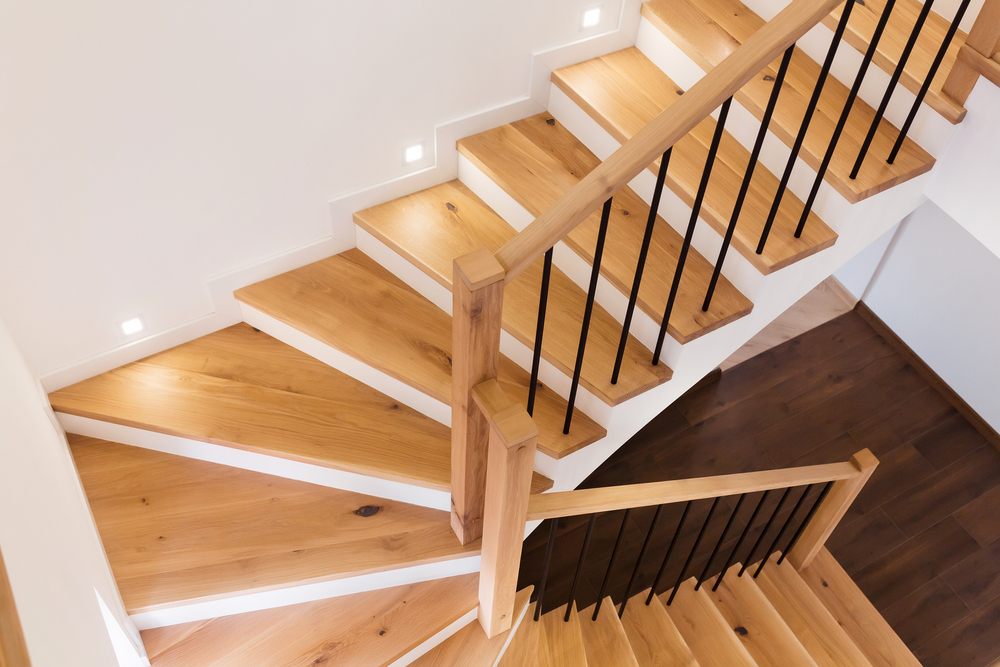
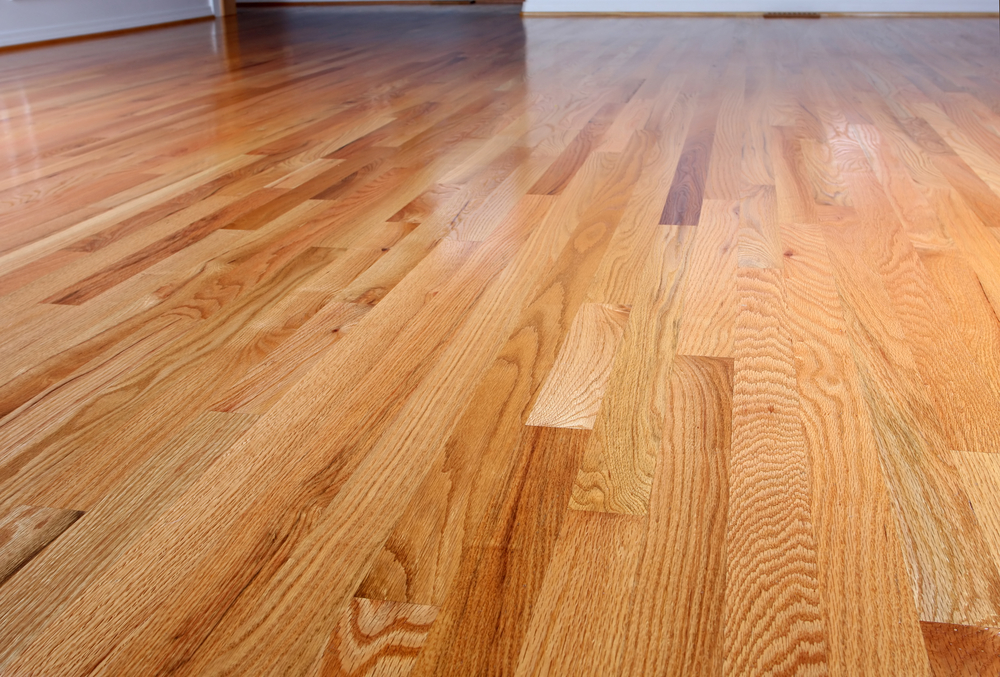
A hardwood hallway can look freshly finished while the staircase beside it tells a different story. In homes around Vancouver’s 98682 ZIP code, stair treads often show heavier wear, darker aging, old stain colors, or finish damage long before the surrounding hardwood needs replacement.
The good news is that mismatched stairs do not automatically mean you need a new staircase.
Quick answer:Hardwood stair refinishing can often bring existing treads much closer to the color, sheen, and overall appearance of an adjoining hardwood hallway without replacing the staircase. The process typically involves evaluating the wood species and condition, removing the worn finish, preparing the existing treads, testing stain or natural finish options, and applying a new protective finish. Exact color matching is not always possible because stairs and hallway flooring may have aged differently, but careful refinishing can create a much more intentional transition.
What local homeowners should know
Existing solid hardwood stair treads can often be refinished when the wood itself remains structurally sound.
Homes in east Vancouver and the 98682 area may have stairways that receive substantially more concentrated foot traffic than nearby hall flooring.
Natural light from entryways, upstairs windows, and open stairwells can cause stairs and hallway flooring to age at different rates.
Matching involves more than stain color because wood species, sanding, existing finish, age, and sheen all affect the final appearance.
Refinishing is different from replacing worn, cracked, loose, or structurally damaged stair components.
Why Hardwood Stairs and Hallways Stop Matching
Hardwood stairs and hallways stop matching because they experience different levels of traffic, sunlight, cleaning, finish wear, and previous refinishing, even when they were originally installed with the same wood. In Vancouver homes, an upstairs hall may retain much of its original finish while each stair tread receives repeated concentrated wear in the same walking path.
Staircases are unusual hardwood surfaces because people repeatedly step in nearly identical places. The center and front edge of each tread can therefore wear differently from both the surrounding tread and the hallway above it.
Sun exposure can create another difference. Homes around 98682, including properties near Cascade Park, Fisher’s Landing, Evergreen, and Hearthwood, often have layouts where a stairwell receives light from an entry, landing, or second-story window. Over time, exposed wood can change color differently from flooring in a more shaded hallway.
Previous renovations matter too. A hall may have been refinished while the stairs were left untouched, or the staircase may have received a darker stain during an earlier remodel.
Au Natural Hardwood Floors works with hardwood flooring and stair surfaces in the Vancouver area. When we evaluate a stair-to-hall transition, the goal is to understand what can realistically be matched before deciding how the existing wood should be refinished.
Local Field Observations for Vancouver Hardwood Stairs
A common local pattern is stair wear that becomes obvious before the adjoining hardwood hall looks ready for refinishing. This is a professional field observation rather than a published local statistic, and the difference is largely explained by how stair treads concentrate footsteps, edge wear, household traffic, and repeated cleaning into relatively small areas.
Southwest Washington’s seasonal moisture changes can also affect wood surfaces and the way finishes age. Vancouver typically moves through cool, wet months and much drier summer periods. Indoor heating during cooler weather and seasonal changes in household humidity can contribute to normal wood movement.
That does not mean the regional climate is responsible for every stair problem. Gaps, squeaks, cracks, looseness, or discoloration should be evaluated individually rather than blamed automatically on moisture.
How Refinishing Helps the Stairs Match the Hall
Refinishing helps stairs match the hallway by removing worn surface finish and creating a new color and sheen relationship between the two hardwood areas. The best result comes from treating the hall as the visual reference while accounting for differences in wood species, age, grain, previous stain, and natural color variation.
The process may include sanding the stair treads to expose clean wood, preparing corners and edges, evaluating color options, and applying a compatible finishing system.
Color is only part of the equation.
A satin hallway beside glossy stairs can look mismatched even when the stain is close. Likewise, two pieces of the same wood can take stain differently because of grain patterns or previous sanding.
For that reason, small samples or test areas can be especially useful before committing to a final appearance.
Warning Signs Your Stair Treads May Need Refinishing
Stair treads may be candidates for refinishing when the damage is primarily in the finish rather than the structure of the staircase. Vancouver homeowners should look closely at both the walking surface and tread edges because worn finish can become progressively more visible when it sits beside a better-preserved hardwood hallway.
Common signs include:
Finish that looks dull or noticeably thinner in the center of the tread
Bare-looking wood where the protective coating has worn away
Scratches that are widespread rather than isolated
A stair color that looks dramatically different from the adjoining hall
Uneven sheen from tread to tread
Dark traffic paths or worn front edges
Previous stain or coating that no longer fits an updated hardwood floor
Surface wear that remains visible after routine cleaning
Deep cracks, movement, significant damage, or loose stair components require a different evaluation than ordinary finish wear.
When to Call a Hardwood Flooring Professional
Professional evaluation makes sense when matching the hallway matters, the stairs have an unknown finish history, or sanding mistakes could permanently alter tread profiles and edges. Homeowners can safely monitor wear and keep the staircase clean, but refinishing involves material removal and finishing choices that are difficult to reverse once the work begins.
Stairs also require more detailed sanding than an open room. Corners, riser transitions, nosing, walls, balusters, and trim can restrict equipment access.
A professional can also help determine whether the apparent mismatch is mostly finish-related or whether the underlying wood itself differs from the hallway.
That distinction matters in Vancouver homes that have been remodeled in stages.
Common Causes of Mismatched Hardwood Stairs in 98682
The most common causes of mismatched hardwood stairs in 98682 are concentrated wear, different finishing histories, sunlight exposure, and differences in the underlying wood. Identifying which factor is responsible helps determine whether refinishing alone can provide the visual continuity a homeowner wants.
1. Heavy foot traffic
Every trip upstairs places pressure on a relatively narrow path. A hallway spreads wear over a much larger area.
2. Separate refinishing projects
The hall may have been sanded or recoated during a previous renovation while the staircase remained unchanged.
3. Sunlight and natural aging
Windows near stair landings or entrances can affect how exposed hardwood changes color over time.
4. Different wood species or grades
A staircase and hallway can look similar under dark stain while actually being made from different materials. Once stripped, those differences may become more apparent.
5. Different finish sheen
A gloss difference can exaggerate an otherwise modest color variation.
6. Previous repairs
Individual treads may have been replaced or patched at different times, creating variations that become noticeable during refinishing.
Maintaining Refinished Stairs in Southwest Washington
Refinished hardwood stairs last best when homeowners limit grit, moisture, abrasive cleaning, and unnecessary wear while maintaining reasonably stable indoor conditions. In Clark County, wet-season debris near entrances can easily travel onto hardwood surfaces, so keeping outdoor moisture and grit away from the staircase is particularly useful during fall and winter.
Use flooring-appropriate cleaning products and avoid soaking the treads. Small amounts of standing water should be wiped up promptly.
Entry mats can help trap outdoor grit before it travels through the home. Regular gentle cleaning also reduces the fine abrasive particles that can gradually dull a finish.
If the stairs begin losing sheen in traffic areas, ask about maintenance before waiting until exposed wood becomes obvious.
DIY maintenance should generally stop at cleaning and routine care unless you understand the existing finish system. Applying an incompatible coating or spot stain can make later refinishing more complicated.
What Results Can You Expect From Stair Refinishing?
Homeowners can expect refinishing to make worn hardwood stairs look cleaner, more consistent, and substantially better coordinated with nearby flooring, but they should not expect every tread to become visually identical to the hallway. Wood is a natural material, and age, grain, species, previous coatings, and sun exposure can all influence the final color.
A successful project may make the transition feel intentional even when subtle differences remain.
That is often a more realistic objective than trying to force two differently aged hardwood surfaces into an artificial exact match.
Common Stair Refinishing Mistakes
The biggest refinishing mistakes occur when homeowners focus only on stain color and overlook wood condition, sanding, sheen, and the existing hallway finish. These details are particularly noticeable on open staircases found throughout Vancouver because the stairs and adjoining floor may be visible together from several angles.
Mistake: Choosing stain from a small store sample alone. Consequence: The color can look very different on the actual tread. Better approach: Evaluate samples on comparable wood whenever practical.
Mistake: Ignoring finish sheen. Consequence: Matching colors can still look noticeably different. Better approach: Consider color and sheen together.
Mistake: Aggressively sanding tread edges or nosing. Consequence: The tread profile can become uneven. Better approach: Use sanding methods appropriate for detailed stair surfaces.
Mistake: Assuming every mismatch can be solved with darker stain. Consequence: Natural grain and species differences may remain while the stairs become darker than intended. Better approach: Identify why the surfaces differ before choosing a finish.
A Common 98682 Stair Refinishing Scenario
A common 98682 scenario involves an upstairs hardwood hallway that still looks relatively even while the staircase below it has darker traffic areas, worn nosing, and an older finish color. The homeowner likes the existing staircase and does not want the cost or disruption of replacing otherwise serviceable hardwood components.
In this situation, the first question is not, “Which stain matches?”
It is whether the existing treads can be prepared to create a compatible appearance with the hall.
After the wood and existing finishes are evaluated, sample colors and sheen levels can help establish a realistic target. The resulting staircase may not duplicate every board in the hallway, but it can often look like the two areas belong together again.
Related Hardwood Flooring Solutions
Related hardwood services can address both the staircase itself and the surrounding flooring when a mismatch extends beyond normal tread wear. Depending on the condition of the home, solutions may include stair tread refinishing, hardwood floor refinishing, finish maintenance, color evaluation, or repair of individual hardwood areas before refinishing.
For Vancouver homeowners who are already planning to refinish an upstairs hall, evaluating the stairs at the same time can help create a more coordinated plan.
Refinishing is generally the better option when existing hardwood treads are sound and the main problem is appearance, while replacement becomes more relevant when stair components are severely damaged, unsuitable, or part of a larger structural renovation. The right choice depends on what is underneath the worn finish rather than how dated the surface looks today.
Refinishing preserves usable existing wood and focuses the project on surface restoration.
Replacement can provide more flexibility when materials need to change completely, but it also involves a more extensive scope.
If your main complaint is that the stairs no longer match the hallway, replacement should not automatically be the first assumption.
Hardwood Stair Refinishing Service Areas
Hardwood stair refinishing is relevant for homeowners throughout Vancouver and nearby Clark County communities where existing hardwood staircases need to coordinate with updated flooring. We serve local flooring needs in the Vancouver area, including homes around 98682 and surrounding communities such as Camas and nearby east Clark County neighborhoods.
What Happens If Worn Stair Finish Is Ignored?
Ignoring worn stair finish can allow normal surface wear to progress until more bare wood is exposed, making maintenance and future restoration more involved. This matters most at tread centers and front edges, where Vancouver households may see concentrated wear from daily traffic.
Cosmetic differences can also become more pronounced as one surface continues aging differently from another.
Addressing the issue does not necessarily mean immediate replacement. It means determining whether maintenance or refinishing makes sense while the existing wood remains suitable for restoration.
Can hardwood stairs in Vancouver be refinished to match an existing hallway?
Yes, hardwood stairs in Vancouver can often be refinished to coordinate closely with an existing hallway when the wood and previous finishes are compatible. Exact matching is not guaranteed because wood changes with age, light exposure, sanding, and finish history, but professional sampling can help identify a color and sheen that creates a cohesive transition.
Do I need to replace old stair treads if the finish is worn?
No, worn finish alone does not necessarily mean stair treads need replacement. If the hardwood remains structurally sound, refinishing may restore the surface without removing the existing staircase. Cracked, loose, severely damaged, or unsuitable treads should be evaluated separately before deciding whether restoration or replacement makes more sense.
Why are my stairs darker than my hallway in a 98682 home?
Stairs can become darker than a hallway because of older stain, finish wear, accumulated traffic patterns, sunlight exposure, or a different refinishing history. In 98682 homes remodeled over several years, it is also possible that the hall and staircase received different coatings or were installed from different batches or species of wood.
Can stair treads be refinished without refinishing the entire floor?
Yes, stairs can often be refinished as a separate project, although the adjoining flooring should be evaluated carefully when matching is the goal. If a Vancouver hallway is in good condition, keeping it intact may be reasonable while using its existing color and sheen as the visual reference for the staircase.
Does Southwest Washington weather affect hardwood stairs?
Southwest Washington’s seasonal moisture patterns can influence indoor wood movement, although interior humidity, heating, ventilation, and individual home conditions are also important. Hardwood should be protected from direct moisture regardless of season. Wet shoes and tracked-in debris during Clark County’s rainy months can also contribute to surface wear near entries and stairs.
Should I choose the exact same stain used on my hallway?
Using the same stain does not automatically produce the same color because different boards, wood species, sanding conditions, and aging can change how stain appears. A better approach is to compare actual samples against the existing hallway under the home’s lighting rather than relying entirely on a stain name or formula.
Can scratched stair treads in Vancouver be repaired without full refinishing?
Some minor surface wear may be manageable through maintenance, but widespread scratching or exposed wood can indicate that refinishing deserves consideration. The appropriate approach depends on the existing coating and depth of damage. Applying a random spot coating can create uneven sheen or compatibility problems, so significant damage should be evaluated first.
Is fall or winter a bad time to refinish hardwood stairs in Vancouver?
Stair refinishing can be considered during different seasons as long as the indoor conditions and finishing requirements are appropriate for the products being used. Vancouver’s wetter fall and winter weather makes controlling tracked-in moisture particularly important, while household scheduling, ventilation, indoor conditions, and product requirements also affect project planning.
Make Your Hardwood Stairs Look Like They Belong With the Floor Again
A worn staircase does not have to undermine an otherwise attractive hardwood hallway. For homeowners in Vancouver and the 98682 area, careful refinishing can often restore existing treads and create a more cohesive transition without automatically replacing the staircase.
Bring Your Staircase and Hardwood Hall Back Into Balance
We can evaluate the existing wood, wear, and finish so you can understand which refinishing options make sense for your home.
Hardwood floor refinishing can temporarily turn a familiar home into an active work zone. For homeowners in Vancouver and across Clark County, the biggest questions are often practical ones: Can we sleep here? Where do the pets go? How much dust should we expect? And when can normal life resume?
Quick answer: You may be able to stay home during parts of hardwood floor refinishing, but you should not assume you can use the house normally throughout the project. Sanding creates noise and some dust, even with dust-control equipment, while stains and finishes can restrict access to rooms and floors. Pets require extra planning because they need to stay completely away from the work area and freshly finished surfaces. Your safest plan depends on the floor layout, products being applied, ventilation, and curing schedule.
What local homeowners should know
Dust-control equipment can substantially reduce sanding dust, but refinishing should not be treated as a completely dust-free project.
Pets should be kept outside the work zone throughout sanding, staining, and finishing, with access determined by the specific finish and curing schedule.
Open floor plans common in many Clark County homes can make it difficult to separate everyday living areas from the project.
Vancouver’s wet-season conditions make it especially useful to plan where people and pets will enter the house without tracking moisture or debris onto newly finished floors.
Furniture, rugs, and normal foot traffic may need to stay off the floor longer than the active sanding portion of the project.
Can You Stay Home During Hardwood Floor Refinishing?
You can sometimes stay home during hardwood floor refinishing if the work area can be isolated and you can avoid the affected floors completely. Staying becomes less practical when refinishing includes the main hallway, kitchen, stairs, or most of the first floor, because those surfaces may temporarily cut off normal routes through the house.
A homeowner refinishing one bedroom may have an easy time living elsewhere in the house. Refinishing continuous hardwood through a kitchen, living room, entry, and hallway is different.
In Vancouver homes with connected main-floor layouts, consider how you will reach bedrooms, bathrooms, exterior doors, and essential appliances without crossing the project area.
Au Natural Hardwood Floors can help homeowners understand the planned work area and access restrictions before refinishing begins. We recommend making your stay-or-go decision around the actual floor plan and finishing process rather than assuming every refinishing project works the same way.
Why Does Staying Home Require Extra Planning in Clark County?
Staying home requires extra planning in Clark County because local households often need to manage wet-weather entryways, pets, connected living spaces, and limited alternate routes through the home. A refinishing project can affect much more than the room being sanded when that floor connects several essential areas.
Residents in places such as Hazel Dell, Salmon Creek, Felida, Orchards, and Fisher’s Landing may have very different layouts, from older homes with separate rooms to newer open-concept spaces.
During wetter periods, another practical concern is keeping outdoor moisture and grit away from newly finished hardwood. A designated entrance and a clear path that does not cross the work area can make daily life much easier.
How Much Dust Should You Expect From Hardwood Floor Refinishing?
Hardwood floor refinishing should be expected to produce some dust because sanding physically removes the existing finish and a thin layer of wood. Professional dust-control systems can capture much of that material at the source, but homeowners should not plan around a promise of absolutely zero dust.
Before work starts, remove small belongings, textiles, pet supplies, and easily contaminated items from the project area. Ask how adjoining spaces, cabinets, doorways, and HVAC openings will be handled.
Homes near Downtown Vancouver, Hough, Arnada, and other established neighborhoods can also have older floor plans with multiple adjoining rooms. Discuss containment before sanding begins so you know which spaces should be cleared.
What Should You Do With Pets During Floor Refinishing?
Pets should be completely separated from the refinishing area because sanding equipment, noise, open doors, coatings, and uncured floors create an environment that is poorly suited to animals. The safest arrangement is often to keep dogs, cats, and other pets somewhere that does not require crossing the work zone.
A closed bedroom is not necessarily enough if reaching the yard requires walking across newly coated hardwood. Boarding, staying with family or friends, or creating a separate section of the house may be more practical.
Ask your flooring professional exactly when pets can return to the finished surface. Do not assume that a floor that feels dry is ready for claws, running, food bowls, beds, or normal pet activity.
What Are the Warning Signs That Staying Home May Be Impractical?
Staying home may be impractical when refinishing blocks essential rooms or makes it impossible to keep children and pets reliably separated from the work. Planning another place to stay can eliminate repeated access problems and reduce the chance of accidentally disturbing a fresh finish.
Watch for these situations:
The project includes most or all of the home’s main level.
Your only route to a bathroom crosses the refinished floor.
The staircase being refinished is required to reach bedrooms.
Dogs must cross the project area to reach an exterior door.
Small children cannot realistically be kept away from the work zone.
A household member is particularly sensitive to dust or odors.
Furniture relocation leaves little usable living space.
The finish schedule requires longer access restrictions than your household can accommodate.
When Should You Ask a Hardwood Flooring Professional About Staying Home?
You should ask about staying home before the refinishing project begins, not after furniture has been moved and sanding is underway. A flooring professional can explain the work sequence, which areas will be inaccessible, what finish is planned, and when people and pets can safely resume specific activities.
For a Vancouver household, useful questions include which entrance will remain available, whether the kitchen can be reached, how stairs will be handled, and when furniture and rugs can return.
The answer should be specific to your project. Product choice, number of coats, floor condition, temperature, humidity, and manufacturer requirements can all affect the schedule.
How Can You Prepare Your Home for Day-to-Day Life During Refinishing?
Preparing your home means creating a temporary living plan before the first sanding pass begins. Decide where you will sleep, eat, work, park pet supplies, and enter or leave the property without interfering with the floor crew or crossing restricted surfaces.
For Clark County households, practical preparation can include moving frequently used items upstairs or into an unaffected room, establishing an alternate exterior entrance, and checking the weather before moving furniture or belongings outside.
During rainy stretches, avoid creating a route that sends everyone from a wet driveway or yard directly beside newly finished flooring.
DIY preparation can help, but follow the flooring professional’s instructions about furniture removal, floor coverings, ventilation, and access rather than improvising around fresh coatings.
What Results Should You Expect After Refinishing?
After refinishing, you should expect access to return in stages rather than all at once. A floor may progress from restricted access to limited foot traffic and eventually to normal use, furniture placement, rugs, and routine cleaning according to the finish manufacturer’s requirements.
This distinction matters for busy homes. “The project is finished” does not necessarily mean “everything can immediately go back where it was.”
We can explain the applicable care and access instructions for the products used on your specific floor so you can plan the transition back to normal household life.
What Common Refinishing Mistakes Disrupt Daily Life?
Common refinishing mistakes usually come from underestimating access restrictions or treating a newly finished floor as ready for normal household traffic too soon. A little planning can prevent unnecessary disruptions and help protect the finished surface.
Mistake: Keeping a dog in a back room without considering its route outside. Consequence: The dog may eventually need to cross the project area. Better approach: Arrange pet access before work starts.
Mistake: Leaving everyday essentials inside an inaccessible room. Consequence: You may be tempted to cross restricted flooring. Better approach: Move medications, chargers, clothes, work equipment, and children’s necessities beforehand.
Mistake: Putting rugs or furniture back based on guesswork. Consequence: A finish that is dry to the touch may still have additional curing requirements. Better approach: Follow the product-specific return-to-use instructions.
What Is a Common Clark County Refinishing Scenario?
A common Clark County scenario is a household refinishing continuous hardwood through the entry, living area, dining space, and kitchen. The family initially expects to remain home because the bedrooms are unaffected, but the project effectively removes the main routes between several essential spaces.
Add a dog that normally uses a back door and a rainy Vancouver forecast, and logistics quickly become more complicated.
In a situation like this, temporarily staying elsewhere may be more convenient than repeatedly trying to navigate around the work. For a smaller isolated room, remaining home may be perfectly manageable.
What Hardwood Floor Refinishing Solutions Can Make the Process Easier?
Professional hardwood floor refinishing can make the process easier when the project is planned around both the floor and the household using it. Sanding, surface preparation, staining when applicable, finish application, dust management, and a clear access schedule should work together.
We encourage homeowners to discuss pets, children, work-from-home needs, entrances, stairs, and essential rooms during project planning.
Staying home is usually more practical for a small, isolated refinishing area, while temporarily relocating may be easier when the project affects major circulation routes or most of the home’s hardwood. The right choice depends less on square footage alone and more on how the affected floors connect your daily activities.
Staying home can reduce inconvenience if you have a truly separate living area. Leaving can simplify pet management, eliminate concerns about accidentally entering restricted areas, and make a whole-level project easier to schedule around.
Ask for the expected sequence before deciding.
Where Does Au Natural Hardwood Floors Serve?
We serve homeowners seeking hardwood flooring solutions in Vancouver and surrounding Clark County communities. Depending on project location and availability, homeowners in areas such as Hazel Dell, Salmon Creek, Felida, Orchards, and nearby communities can contact us to discuss their flooring needs.
What Can Happen If You Ignore Refinishing Access Instructions?
Ignoring refinishing access instructions can interfere with the finished surface and create unnecessary rework. Foot traffic, pet claws, rugs, furniture, or household activity introduced before the applicable return-to-use time can affect a finish that has not reached the appropriate stage of curing.
The simplest solution is to know the schedule beforehand. Build extra flexibility into your household plans rather than assuming you will regain full access immediately after the final application.
Can I sleep in my Vancouver home while the hardwood floors are being refinished?
You may be able to sleep in your Vancouver home if the bedrooms remain accessible without entering the work zone and the products being used allow it. The project layout and finish matter. Ask your flooring professional about ventilation, access, and product-specific precautions before deciding to remain overnight.
Can my dog stay home during hardwood floor refinishing in Clark County?
Your dog should not have access to the refinishing area during the project. Whether the dog can remain elsewhere in the Clark County home depends on whether there is a completely separate, practical route for feeding, bathroom breaks, and outdoor access. Temporary off-site care can be easier for many households.
Is hardwood floor refinishing completely dust-free?
No. Professional dust-control equipment can substantially reduce airborne sanding dust, but homeowners should not interpret “dust controlled” as a guarantee that absolutely no dust will escape. Remove sensitive belongings from the work area and ask how adjacent rooms and openings will be protected before sanding begins.
Does Vancouver’s rainy weather affect planning for refinished floors?
Rainy weather can affect household logistics because wet shoes, muddy paws, and outdoor moisture need to remain away from newly finished hardwood. Vancouver homeowners should establish an unaffected entrance when possible and follow their flooring professional’s instructions about ventilation, curing, and when normal traffic can resume.
How soon can pets walk on refinished hardwood floors?
Pets should return only after the applicable finish instructions say the surface is ready for them. Drying and curing are not necessarily the same thing, and claws can place different demands on a surface than careful human foot traffic. Follow the instructions for the exact finishing product used.
Should I leave my Clark County home for the entire refinishing project?
You do not necessarily need to leave for the entire project, but relocating can be more convenient when sanding and finishing affect most of the home’s usable floor area. Ask for the project sequence first, then identify whether you can reach bedrooms, bathrooms, entrances, and other essentials without entering restricted areas.
Can I work from home during floor refinishing in Vancouver?
You may be able to work from home if your workspace is well separated from the project, but sanding equipment and other project activity can create significant daytime noise. Consider calls, internet access, room access, and your tolerance for disruption before planning a normal workday during refinishing.
When can furniture and rugs go back after hardwood refinishing?
Furniture and rugs should return according to the instructions for the specific finishing system used on your floor. Do not use the same timeline for every coating or assume that a walkable surface is ready for rugs and heavy furniture. Your flooring professional should provide project-specific guidance.
Make Hardwood Floor Refinishing Easier on Your Clark County Household
Refinishing does not have to make daily life chaotic. Knowing where people and pets will go, which rooms will remain accessible, and when the finished floor can return to normal use makes it much easier to plan a Vancouver-area project.
Plan Your Vancouver Hardwood Floor Refinishing With Confidence
We can help you understand the refinishing process, household access, and what to expect before work begins.
Older homes around historic downtown, NE Everett Street, and established parts of Camas can have hardwood floors with decades of character beneath their finish. They can also hide problems that are easy to miss until boards start squeaking, separating, cupping, or showing uneven wear.
Quick answer:Hardwood floors in older homes often need a different approach than flooring in newer construction. Aging subfloors, previous repairs, moisture movement, floor height changes, and multiple layers of old finish can all affect whether a floor should be repaired, refinished, or partially replaced. The right solution starts with understanding what is happening beneath the visible surface rather than assuming every worn floor needs replacement.
What local homeowners should know
Older hardwood can often be worth evaluating for repair or refinishing before deciding to replace it.
Camas has homes dating to the early 1900s, including documented historic residences in Clark County records.
Western Washington’s wet season makes moisture conditions around crawl spaces, entries, and exterior walls especially important when evaluating wood flooring.
Squeaks, gaps, discoloration, and uneven boards can come from different causes, so one repair method does not fit every floor.
Matching the width, species, thickness, and appearance of an older floor can be one of the most challenging parts of a localized repair.
Why Do Hardwood Flooring Problems Show Up Differently in Older Camas Homes?
Hardwood flooring problems show up differently in older Camas homes because the flooring, subfloor, framing, and previous renovations may reflect several generations of construction practices. A floor that looks like one continuous surface may actually include old patches, additions, altered doorways, repaired joists, or sections installed many years apart.
The age of local housing matters. The City of Camas was incorporated in 1906, and Clark County records document local residences from the early 1900s, including the circa-1901 Pittock-Leadbetter House and circa-1906 John Roffler House. That does not mean every older home has original hardwood, but it demonstrates how long wood-frame residential construction has been part of the community.
In established areas near historic downtown and the older street grid, flooring work may involve conditions that are less common in newer developments around Prune Hill and other recently built neighborhoods.
Au Natural Hardwood Floors approaches these projects by looking at the floor as part of the house rather than treating the visible boards as an isolated surface. After this first mention, we focus on what the wood, subfloor, and surrounding conditions tell us about the appropriate next step.
What Flooring Issues Do We Commonly Look for in Older Local Homes?
The flooring issues we look for in older local homes include board movement, damaged patches, worn finishes, uneven transitions, subfloor movement, and evidence of moisture exposure. Some problems are cosmetic, while others point to conditions underneath the hardwood that should be understood before sanding, refinishing, or installing new material.
Common warning signs include:
Boards that move or flex under normal foot traffic
Persistent squeaks concentrated in one section
Gaps that appear unusually wide or inconsistent
Boards with raised edges or a cupped appearance
Dark staining around exterior doors, plumbing areas, or old leaks
Previous repair patches that no longer sit flush with surrounding flooring
Finish that has worn through to bare wood in traffic lanes
Noticeable floor-height changes between rooms
One sign alone does not automatically mean the floor needs replacement. The pattern and underlying cause matter more than the appearance of a single board.
How Does Southwest Washington Moisture Affect Hardwood Floors?
Southwest Washington moisture can affect hardwood floors because wood naturally responds to changes in its surrounding environment, and prolonged moisture exposure can create more serious movement or damage. In the Camas area, crawl spaces, plumbing leaks, wet entry areas, and exterior drainage deserve attention whenever wood shows unusual swelling, staining, or distortion.
Seasonal expansion and contraction are normal to a degree. Persistent cupping, soft areas, or dark staining deserve a closer look because finishing over an unresolved moisture source does not correct the underlying condition.
Homes near Lacamas Lake, wooded properties, and houses with shaded crawl spaces may have site conditions that differ substantially from newer, more exposed developments. The condition of the individual home matters more than its proximity to any single landmark, so moisture should be evaluated at the property itself.
What Causes Squeaking and Movement in Older Hardwood Floors?
Squeaking and movement in older hardwood floors usually occur when components of the flooring system move against one another, including finished boards, subfloor materials, fasteners, or framing. In an older Clark County home, years of settling, remodeling, fastener movement, and changing indoor conditions can contribute to noise without making the hardwood itself unusable.
A few common causes are:
Movement between boards. Older boards can develop slight movement as the floor system ages.
Subfloor movement. A sound may originate below the finished hardwood rather than from the board you can see.
Loose or aging fasteners. Movement around fastening points can produce recurring squeaks.
Previous remodeling. Removed walls, patched openings, additions, and altered room layouts can create transitions between old and newer floor systems.
Moisture-related movement. Changes in wood dimensions can make an existing problem more noticeable.
Finding the source is important because adding a surface fastener in the wrong place may hide the sound temporarily without resolving its cause.
When Should Damaged Hardwood Be Repaired Instead of Replaced?
Damaged hardwood should generally be considered for repair when the affected area is limited and the surrounding floor remains structurally suitable for continued use. Replacement becomes more practical when damage is widespread, the flooring cannot be successfully restored, or underlying conditions require extensive removal to correct.
Older floors can be especially worth evaluating before demolition. Some have material dimensions or visual characteristics that are difficult to reproduce exactly with modern products.
Localized repair may make sense for isolated stains, damaged boards, old vent openings, altered walls, or limited sections affected by a past problem. Larger replacement areas may be appropriate when damage extends well beyond a few boards or when the existing flooring is no longer a suitable surface to restore.
The goal is not to save every board at any cost. It is to preserve usable material where practical while creating a stable, visually coherent floor.
What Makes Matching Old Hardwood Flooring Difficult?
Matching old hardwood flooring is difficult because board dimensions, wood species, milling, grain, oxidation, finish history, and decades of exposure can make an existing floor look different from newly installed material. Even wood of the same species may not immediately blend with boards that have aged inside a home for generations.
For a repair, we consider more than color. Width and thickness affect how the patch fits. Grain and grade affect how it looks. Existing sanding history can also affect how much material remains above the tongue-and-groove joint.
Fresh repair boards may initially appear different from surrounding wood. Refinishing a larger continuous area can sometimes create a more unified appearance, but homeowners should expect some natural variation when new material meets genuinely older flooring.
When Should a Hardwood Floor Be Professionally Evaluated?
A hardwood floor should be professionally evaluated when there is widespread movement, recurring moisture damage, significant staining, extensive finish failure, uncertain flooring thickness, or a repair that requires removing and replacing boards. These conditions can involve more than surface appearance and may require decisions about both the flooring and what lies beneath it.
Homeowners can safely monitor minor seasonal gaps, note where squeaks occur, and watch whether a stain changes after wet weather or a plumbing event.
DIY investigation should stop before aggressive sanding, pulling boards, or fastening blindly into an unknown floor system. Those steps can make a repair more difficult if the original cause has not been identified.
For a house on or eligible for a historic register, property owners should also verify whether special review requirements apply before undertaking work that could affect protected historic features. Clark County maintains its Heritage Register and review process for listed properties.
How Can Homeowners Help Prevent Hardwood Floor Problems?
Homeowners can help prevent hardwood floor problems by controlling water exposure, maintaining stable interior conditions, protecting high-traffic areas, and addressing leaks quickly. In the Pacific Northwest, paying attention to wet-season conditions is particularly useful because moisture can reach flooring from above, below, or adjacent building components.
Practical steps include:
Wipe up tracked-in rain and standing water promptly.
Use entry mats without leaving moisture trapped beneath them.
Investigate plumbing leaks instead of waiting for wood discoloration to spread.
Keep gutters, downspouts, and exterior drainage functioning properly.
Pay attention to crawl-space moisture or musty conditions.
Use protective pads under furniture.
Avoid repeatedly wet-mopping wood floors.
Have worn finish evaluated before traffic wears deeply into exposed wood.
Fall is a useful time for local homeowners to check entries and moisture-prone areas before the wetter months. Spring can be a good time to review any changes that became noticeable during winter.
What Results Can You Expect From Hardwood Floor Repair or Refinishing?
Hardwood floor repair or refinishing can improve appearance, address localized damage, reduce visible wear, and extend the useful life of flooring when the existing material is a good candidate. The exact result depends on the floor’s age, remaining thickness, previous sanding, stains, repairs, wood characteristics, and underlying condition.
Refinishing can renew a worn surface, but it cannot correct every structural issue underneath it. Likewise, replacing damaged boards can address a localized problem without making century-old and newly milled wood visually identical.
A proper evaluation helps set realistic expectations before work begins.
What Mistakes Can Make an Older Hardwood Floor Harder to Repair?
The most common mistakes with older hardwood floors are sanding too aggressively, ignoring moisture, using mismatched repair material, and assuming a cosmetic fix will correct movement below the surface. These choices can turn a manageable flooring problem into a larger project or remove material that cannot easily be put back.
Mistake: Sanding deeply to remove a stubborn stain. Consequence: Too much wood may be removed from a floor that has already been refinished in the past. Better approach: Determine the floor’s condition and remaining usable thickness before aggressive sanding.
Mistake: Replacing boards before correcting moisture. Consequence: New material may develop the same symptoms. Better approach: Identify the source of abnormal moisture first.
Mistake: Choosing repair boards based only on color. Consequence: Width, grain, thickness, or milling may create an obvious patch. Better approach: Evaluate the physical characteristics of the existing floor before selecting repair material.
Mistake: Covering an old floor without investigating movement. Consequence: Squeaks or instability can remain beneath the new surface. Better approach: Understand whether the existing assembly is stable enough for the proposed flooring system.
What Is a Common Older-Home Flooring Scenario in Camas?
A common older-home flooring scenario in Camas involves an attractive hardwood floor that looks generally sound but has one or two problem areas created by past remodeling, water exposure, or normal wear. A homeowner may notice darker boards near an exterior wall, a patched doorway, or squeaking concentrated around one section.
The important point is that the rest of the floor may not need to be discarded simply because one area has a problem.
We would first want to understand the extent of the affected area, the construction beneath it, and whether the source of damage is still active. From there, repair, refinishing, partial replacement, or a combination of approaches can be considered.
Which Hardwood Flooring Services Can Address These Problems?
Hardwood flooring services can address these problems through evaluation, board repair, refinishing, installation, and replacement where appropriate. The correct service depends on whether the problem is primarily in the finish, individual boards, a larger flooring section, or the underlying floor system.
For older properties, a thoughtful sequence matters. Repairing damaged material before refinishing can help the finished project read as one floor. During a larger remodel, coordinating flooring installation with transitions, trim, door clearances, and adjoining rooms can also prevent avoidable complications.
Should You Choose Repair, Refinishing, or Replacement?
Repair, refinishing, or replacement should be chosen based on the condition of the wood rather than its age alone. An old floor with localized damage may remain a good repair candidate, while a newer floor with extensive moisture or structural damage may require more substantial work.
Repair is best suited to isolated damaged boards, old openings, small patches, and specific problem areas.
Refinishing is most useful when the flooring remains serviceable but its protective surface is worn, scratched, dull, or uneven.
Replacement becomes more appropriate when damage is widespread, the existing material cannot support another restoration, or the intended renovation requires a different flooring system.
For many older houses, the answer can also be a combination: repair the problem areas, then refinish the larger continuous floor.
Where Do We Provide Hardwood Flooring Services Locally?
Our hardwood flooring work serves homeowners in Camas and surrounding Southwest Washington communities where older and newer housing often require different flooring approaches. Nearby areas such as Washougal and Vancouver also contain a mix of established properties, remodeled homes, and newer construction.
Each house should be evaluated based on its actual flooring and site conditions rather than assumptions based solely on ZIP code or neighborhood.
What Can Happen If Hardwood Floor Damage Is Ignored?
Ignoring hardwood floor damage can allow a limited problem to become more difficult or expensive to address, especially when active water exposure or continued board movement is involved. Surface wear can also deepen once the protective finish is gone, allowing traffic and spills to affect the wood itself.
A small seasonal gap may simply deserve monitoring. An expanding stain, soft flooring, persistent cupping, or an area that continues to move deserves more attention.
Older Camas homes often reward careful preservation, and early evaluation can provide more options than waiting until damaged material has deteriorated further.
Frequently Asked Questions About Hardwood Floors in Camas, WA
Can original hardwood floors in older Camas homes be saved?
Original hardwood floors can often be considered for repair or refinishing if enough usable material remains and serious underlying damage is limited. Age by itself does not determine whether a floor is salvageable. Its thickness, previous sanding, board condition, moisture history, and subfloor stability all need to be considered before deciding.
Why are my hardwood floors separating during certain times of year?
Seasonal hardwood gaps can occur because wood responds to changes in its surrounding environment. Small changes may be normal, while unusually large or persistent gaps can indicate other conditions. In Southwest Washington, it is useful to compare what happens during wetter months with conditions during the drier part of the year.
Does Camas weather cause hardwood floors to cup?
Moisture imbalance can contribute to hardwood cupping, but the local weather alone should not automatically be blamed. Plumbing leaks, crawl-space conditions, wet entries, drainage issues, and indoor humidity can also influence a floor. Persistent cupping should be investigated so the moisture source can be understood before cosmetic repairs begin.
Are squeaky floors common in older Clark County homes?
Squeaks can occur in older Clark County homes because flooring systems may have experienced decades of movement, remodeling, and fastener wear. The noise may come from the hardwood, subfloor, or framing beneath it. Locating the source is more useful than simply driving fasteners through the visible floor at random.
Can you match hardwood when only a few boards need repair?
A close hardwood match may be possible, but an exact match cannot always be expected with an older floor. Board width, thickness, species, grain, milling, age, and existing finish all matter. Newly installed wood can also look different initially because surrounding boards have had years to change naturally in appearance.
Should I refinish hardwood before selling an older Camas home?
Refinishing may make sense before selling when the floor is structurally suitable and surface wear is the main problem, but it should not automatically be the first step. If boards are loose, damaged, stained, or affected by moisture, those conditions should be evaluated before refinishing so underlying problems are not simply covered.
Can water-stained hardwood be sanded instead of replaced?
Some surface discoloration may improve during refinishing, while deeper staining may remain visible even after sanding. Removing excessive wood in pursuit of a stain can damage a floor, particularly if it has been refinished before. A professional evaluation can help determine whether sanding, board repair, or replacement is the more appropriate approach.
Do historic homes in Camas have special flooring requirements?
Some historically designated properties may have additional review considerations depending on the property’s listing and the work being proposed. Clark County maintains a Heritage Register and a Certificate of Appropriateness process for applicable historic resources. Owners of registered properties should verify requirements before altering historically significant materials.
Protect the Character and Performance of Your Hardwood Floors
Older hardwood deserves an approach that respects both the material you can see and the structure beneath it. We help local homeowners evaluate repair, refinishing, and installation options with the goal of finding a practical solution for the condition of the individual home.
Keep Your Camas Hardwood Floors Looking and Performing Their Best
Get clear guidance on whether your floor needs repair, refinishing, new installation, or a closer look at an underlying problem.
A hardwood floor can look ready for refinishing while still having problems underneath the surface. In Vancouver, WA, squeaks, movement, popping sounds, or loose boards can point to fastening, subfloor, moisture, or structural conditions that sanding and a new finish will not correct.
Before refinishing a noisy or moving hardwood floor, find out why it is moving.
Quick answer: Squeaky, loose, or popping hardwood floors should usually be evaluated and repaired before refinishing. Sanding improves the surface of the wood, but it does not secure loose boards, correct movement in the subfloor, or resolve an active moisture problem. Repairing the underlying cause first gives the refinishing work a more stable surface and reduces the chance that the same symptoms will remain after the floor looks new.
What local homeowners should know
A squeak by itself may be caused by wood rubbing against another board, a fastener, or the subfloor, but widespread movement deserves closer inspection.
Vancouver’s rainy season can make moisture conditions especially relevant when flooring problems change noticeably through the year.
Older homes in neighborhoods such as Arnada, Shumway, Hough, and Bagley Downs may have flooring systems that have been repaired, refinished, or altered multiple times.
Sanding a loose floor does not tighten it, and finishing over an unresolved moisture condition can leave the real problem untouched.
Repairs are generally easier to plan before sanding removes the existing finish and the entire floor enters the refinishing process.
Why Should Hardwood Floor Problems Be Repaired Before Refinishing?
Hardwood floor problems should be repaired before refinishing because refinishing changes the surface, while squeaks, looseness, and popping often originate below or between the boards. If movement remains after sanding and coating, a floor can look dramatically better but still make the same sounds or continue shifting underfoot.
A refinish is designed to address worn finish, scratches, discoloration, and other surface deterioration. Repair work addresses physical problems such as loose boards, inadequate fastening, localized subfloor movement, damaged flooring, or moisture-related movement.
That distinction matters in Vancouver, WA, where seasonal moisture changes can affect wood products inside a home. A good refinishing plan starts with determining whether the floor is stable enough to refinish in the first place.
Au Natural Hardwood Floors helps local property owners evaluate hardwood flooring before moving forward with refinishing. We look at the condition of the existing floor so repair needs can be addressed as part of the overall project rather than hidden beneath a new finish.
What Local Conditions Can Affect Hardwood Floors?
Local hardwood floors can be affected by seasonal moisture changes, the age and construction of the home, previous flooring work, and conditions beneath the finished boards. Southwest Washington’s climate includes a long wet season followed by comparatively dry summer weather, creating changing moisture conditions that wood floors must accommodate.
National Weather Service climate information for the Portland-Vancouver region shows that most annual rainfall occurs from fall through spring, with substantially drier conditions during July and August. Wood naturally responds to surrounding moisture conditions by expanding and contracting.
That does not mean normal seasonal movement should make a floor noticeably loose. Instead, seasonal changes may reveal an existing weakness in fastening, gaps, subfloor support, or moisture control.
The housing stock also varies considerably across Clark County. The City of Vancouver describes Arnada as one of its oldest neighborhoods and notes homes dating from the 1940s and 1950s in Bagley Downs. Floors in established neighborhoods may have decades of wear, previous repairs, additions, or remodeling behind what is visible today.
What Are the Warning Signs That a Floor Needs Repair?
A floor may need repair before refinishing when movement, sound, gaps, or surface changes suggest the boards are not simply suffering from finish wear. The most useful clues are symptoms that can be felt or heard, particularly when they occur repeatedly in the same location.
Watch for:
Boards that move vertically when stepped on.
Persistent squeaking concentrated along a seam or traffic path.
Popping or clicking noises as weight moves across the floor.
Individual boards that feel loose compared with surrounding flooring.
Raised edges, cupping, or unusual changes in board shape.
Gaps that become unusually large or change significantly by season.
Dark staining or other signs that moisture may have reached the wood.
Previous patching or fastening that appears to have failed.
A small isolated squeak and a floor that visibly flexes across a larger area are not the same problem. The pattern helps determine what should happen next.
What Commonly Causes Squeaky or Loose Hardwood Floors?
Squeaky and loose hardwood floors are commonly caused by movement between flooring components, weakened fastening, subfloor movement, damaged boards, or changing moisture conditions. Identifying which components are moving is more useful than treating every floor noise as the same repair.
One common cause is friction. A board may rub against another board, a fastener, or the subfloor when someone walks across it. If fasteners are no longer holding the flooring tightly, movement may become more noticeable.
Subfloor conditions can also contribute. Movement underneath finished hardwood can produce noise even when the flooring itself still appears attractive from above.
Moisture deserves particular attention around kitchens, exterior doors, plumbing fixtures, crawlspaces, and other areas where conditions can differ from the rest of the home. In the Columbia River region, homeowners should also pay attention when symptoms become more pronounced during the wetter months.
The correct repair depends on what is actually moving and why.
Can You Refinish a Squeaky Hardwood Floor Without Repairing It?
A squeaky hardwood floor can sometimes be refinished without repair, but refinishing should not be expected to eliminate a squeak caused by movement beneath the surface. If the sound is related to loose flooring or the subfloor, sanding and applying finish will not correct the mechanical source of the noise.
This is where proper evaluation prevents mismatched expectations.
If an otherwise stable floor has a minor sound that does not indicate a larger problem, homeowners may decide to live with it. If boards move underfoot, noises are widespread, or the condition appears to be worsening, repair deserves attention before refinishing.
For homeowners in Vancouver, WA, combining the evaluation with the refinishing plan can also reduce the chance of discovering repair needs after surface work has already begun.
What Should Homeowners Check Before Calling a Professional?
Homeowners can safely document where noises and movement occur, look for visible moisture or damaged boards, and notice whether the problem changes by season. They should avoid invasive repairs when the source of the movement is unclear, especially when fastening or moisture conditions beneath the flooring may be involved.
Walk the room slowly and identify whether the symptom occurs in one board, along a seam, near a wall, or across a larger area. Notice whether furniture placement changes the sound.
Also consider what is beneath the room. A crawlspace, basement, or finished ceiling below the flooring can affect how a repair is approached.
DIY diagnosis should stop when boards are visibly shifting, moisture damage is suspected, or accessing the problem requires removing flooring. Driving random screws or nails through finished hardwood can create additional repair work without addressing the underlying cause.
What Results Can You Expect From Repairing Before Refinishing?
Repairing first can provide a more stable floor for refinishing and gives the project a better chance of addressing both appearance and function. The exact result depends on the cause, accessibility, flooring condition, and age of the installation, so not every sound or movement can be assumed to disappear completely.
Localized loose boards may be repairable without replacing an entire room. Damaged boards may sometimes require individual replacement. Broader subfloor or moisture problems may require more investigation before cosmetic work makes sense.
Once appropriate repairs are completed, sanding can address the worn surface and prepare the wood for the selected finishing system.
The goal is not simply to make an old floor look new. It is to avoid investing in refinishing while leaving a known physical problem unresolved.
What Mistakes Should Vancouver Homeowners Avoid?
The biggest mistake is assuming every hardwood flooring problem can be solved by sanding because sanding only addresses the exposed wood surface. Vancouver homeowners should separate cosmetic wear from movement, moisture, and fastening problems before deciding what type of work the floor needs.
Mistake: Refinishing first and investigating the squeak later. Consequence: The floor may still make noise after the refinishing project is complete. Better approach: Identify the source of significant movement before sanding begins.
Mistake: Adding fasteners without knowing what is underneath. Consequence: Visible holes or additional damage can be created without stopping the movement. Better approach: Determine which flooring component is loose before choosing a repair method.
Mistake: Ignoring moisture-related changes. Consequence: A symptom connected to changing moisture conditions may return even after cosmetic improvements. Better approach: Investigate unusual cupping, staining, expansion, or seasonal movement first.
What Is a Common Local Hardwood Floor Scenario?
A common local scenario is an older hardwood floor that still has plenty of visual character but has developed several noisy or moving areas after years of use. In established Vancouver, WA, neighborhoods, the floor may also have undergone previous refinishing or remodeling that is not obvious until the current project is evaluated.
Imagine a homeowner near Uptown Village preparing to refinish a worn living room and hallway. The finish is scratched, but two areas also squeak and one board moves slightly underfoot.
Instead of treating everything as surface wear, the moving areas are evaluated first. Needed repairs can then be completed before the floor is sanded.
This is a common scenario, not a specific customer case. It illustrates why sequencing matters.
Which Hardwood Flooring Services May Be Needed?
The services needed may include hardwood floor evaluation, localized repair, board replacement, and refinishing, depending on what is causing the symptoms. A floor with cosmetic wear alone requires a different plan from one with loose boards, damaged wood, or movement that originates underneath the finished surface.
Our approach is to consider repair needs before the refinishing process so homeowners understand what each portion of the work is intended to accomplish.
Repair is often worth considering when the majority of an existing hardwood floor remains serviceable and the problem is limited to specific areas, while replacement becomes more relevant when damage or instability is extensive. The right choice depends on the condition of the wood, subfloor, affected area, and desired finished result.
For a few loose or damaged boards, localized work may preserve much more of the existing floor. When problems affect large sections or involve conditions that cannot be corrected locally, the scope may be different.
A professional evaluation helps separate isolated defects from broader flooring-system problems before money is committed to either option.
Where Do We Provide Hardwood Floor Services?
We serve hardwood flooring customers in Vancouver, WA, and the surrounding Clark County area. Depending on project location and service availability, homeowners in nearby communities such as Camas, Washougal, Ridgefield, and Battle Ground can contact us to discuss their flooring needs.
Local homes range from older properties near downtown and Fort Vancouver to newer construction farther east and north, so flooring conditions can vary considerably from one project to another.
What Can Happen If You Ignore a Loose or Popping Floor?
Ignoring a loose or popping hardwood floor can allow continued movement to wear connections between boards, damage edges, or make an underlying problem harder to address later. The risk varies by cause, so an isolated harmless noise should not be treated the same way as flooring that visibly shifts or shows moisture-related damage.
Waiting also complicates refinishing decisions. If you already plan to sand and refinish the floor, discovering a repair issue afterward can mean working on a newly finished surface.
Evaluating suspicious areas beforehand provides clearer options.
Should squeaky hardwood floors always be repaired before refinishing in Vancouver, WA?
Not every squeak automatically requires repair, but noticeable movement or persistent noise should be evaluated before refinishing. Sanding cannot tighten loose boards or stabilize a moving subfloor. If the floor is structurally stable and the sound is minor, refinishing may still be appropriate without extensive repair.
Does Vancouver’s rainy climate cause hardwood floors to squeak?
Vancouver’s climate can contribute to changing moisture conditions, but rain alone does not explain every squeak. Wood responds to changes in moisture, while floor noise usually requires movement somewhere in the flooring system. Seasonal changes may make an existing fastening, gap, or subfloor issue more noticeable.
Can refinishing stop hardwood floors from popping?
Refinishing generally does not stop popping when the sound is caused by boards moving against each other, fasteners, or the subfloor. The source of the movement should be identified first. Once appropriate repairs are addressed, refinishing can improve the worn or damaged surface.
Are squeaky floors more common in older Vancouver homes?
Older homes can have more opportunities for flooring movement because materials, fasteners, repairs, and remodeling have accumulated over decades, but age alone does not determine whether a floor will squeak. Neighborhoods such as Arnada and Bagley Downs include older housing, making careful evaluation particularly useful before refinishing.
Should I worry if my hardwood floor changes between wet and dry seasons?
Some seasonal expansion and contraction is normal for wood, but large changes, visible movement, cupping, or unusually wide gaps deserve attention. Clark County’s wet winters and drier summers can create changing environmental conditions, so tracking when symptoms appear can provide useful information during a flooring evaluation.
Can individual hardwood boards be repaired without replacing the whole floor?
Individual hardwood boards can sometimes be repaired or replaced without removing the entire floor. Feasibility depends on the installation, location, wood condition, and cause of the damage. Localized repair can be especially useful when most of the existing hardwood remains in suitable condition for refinishing.
Should I refinish or replace my hardwood floor?
Refinishing may be appropriate when the existing wood is sufficiently intact and the main problems involve surface wear, while replacement becomes more relevant when damage is extensive or the flooring cannot be made suitably stable. An inspection of the floor and affected areas provides the best basis for choosing.
When should I schedule hardwood floor repair in Vancouver, WA?
Schedule an evaluation before refinishing whenever boards move, pop repeatedly, show signs of moisture damage, or feel different from surrounding flooring. Addressing these symptoms before sanding allows repair and refinishing to be planned in the correct order instead of trying to work around a newly finished surface.
Protect the Floor Before You Renew the Finish
A beautiful refinished floor starts with a surface that is appropriate to refinish. If your hardwood floor squeaks, pops, or moves underfoot, identifying the cause first can help you make a more informed repair and refinishing decision.
Get Your Vancouver Hardwood Floor Ready for Refinishing
We can evaluate problem areas and discuss whether repairs should be addressed before the refinishing process begins.
Hardwood flooring searches in 98682 often start with simple questions: Who installs hardwood floors near me? Can my existing floors be refinished? Is engineered or solid hardwood better for this house? For East Vancouver homeowners, the best answer depends on more than color, plank width, or what looks good in a showroom.
The floor needs to fit the home, the subfloor, the household, and the Pacific Northwest environment.
Quick answer: When choosing hardwood floors in 98682, focus first on the condition of the existing floor or subfloor, moisture conditions, the type of wood flooring, installation method, and whether refinishing or repair could preserve what is already there. Appearance matters, but proper preparation and material selection have a much bigger effect on how a hardwood floor performs over time.
What local homeowners should know
Hardwood flooring should be evaluated for moisture conditions and subfloor suitability before installation begins.
East Vancouver’s wet-season conditions make moisture management especially important around entries, kitchens, sliding doors, and other areas exposed to water.
Homes around Orchards, Heritage, Sifton, and nearby parts of Clark County vary in age and construction, so the right flooring solution is not identical from one property to the next.
Existing hardwood does not always need replacement. Some worn, scratched, or dated floors may be candidates for professional refinishing.
The best hardwood choice balances appearance with durability, maintenance expectations, household traffic, and the home’s existing construction.
Why Hardwood Flooring Choices Matter in 98682
Hardwood flooring choices in 98682 matter because local homes experience a seasonal cycle of wetter, cooler months followed by much drier summer conditions. Wood naturally responds to changes in its surrounding environment, making material selection, acclimation, moisture evaluation, and proper installation especially important in Southwest Washington.
National Weather Service climate normals for Vancouver Pearson Airport reflect the area’s pronounced seasonal shift between wetter winter months and drier summers.
In East Vancouver, that matters whether a home sits near NE Fourth Plain Boulevard, closer to Heritage, or farther east toward the edge of the urban area. Entryways can see wet shoes for months at a time, while indoor heating and summer weather can change interior conditions later in the year.
Au Natural Hardwood Floors works in Vancouver, WA, where those local conditions are part of the flooring conversation. We look beyond the surface appearance of a floor and consider what is underneath it, how the space is used, and what the homeowner expects from the finished result.
What East Vancouver Homeowners Actually Search For
Homeowners searching for hardwood floors in East Vancouver usually want help with one of five decisions: installation, refinishing, repair, material selection, or determining whether an existing wood floor can be saved. Those questions are more useful than simply searching for the lowest flooring price.
Common searches often revolve around:
Hardwood floor installation
Hardwood floor refinishing
Hardwood floor repair
Solid versus engineered hardwood
Scratched or worn hardwood floors
Matching an existing wood floor
Replacing carpet with hardwood
The underlying question is usually the same: What does this particular floor need?
That answer should come before selecting stain colors or comparing finished samples.
Local Data and Flooring Conditions
Local climate data supports paying close attention to moisture and seasonal conditions when working with hardwood in Vancouver. National Weather Service 1991-2020 climate normals document the region’s wetter cool season and comparatively dry summer period.
Clark County also shows that the east side includes established residential areas such as Heritage, while the Orchards area overlaps ZIP codes 98662 and 98682.
For homeowners, the practical takeaway is simple: hardwood should be treated as a building material that responds to its environment, not simply as a decorative surface.
Warning Signs Your Hardwood Floor Needs Attention
Hardwood floors need professional evaluation when changes go beyond normal surface wear or when the source of the problem is unclear. In a 98682 home, especially one with an older floor or a recent moisture event, identifying the cause before choosing a repair can prevent unnecessary replacement.
Watch for:
Boards that feel loose, raised, or unusually uneven
Gaps that appear excessive or change noticeably
Dark staining near exterior doors, sinks, appliances, or windows
Cupped or crowned boards
Deep scratches that extend through the finish
Finish that has worn through in major traffic paths
Squeaks or movement that seem to be getting worse
Sections that no longer match after previous repairs
Surface scratches and dullness may point toward refinishing. Movement, staining, or distortion can require a closer look at moisture or the flooring system underneath.
Common Causes of Hardwood Floor Problems in 98682
Common hardwood flooring problems in 98682 are often connected to moisture exposure, normal wear, installation conditions, or the age of the floor. Homes near Orchards and Heritage may also have very different flooring histories, even when they are only a few miles apart.
1. Repeated moisture exposure: Wet footwear, spills, leaks, and water near exterior openings can affect wood if moisture remains long enough.
2. Seasonal environmental changes: Wood can expand and contract as indoor conditions change through Southwest Washington’s wet and dry seasons.
3. Heavy traffic: Hallways, kitchens, living areas, and routes between garages and main living spaces tend to show wear first.
4. Pet and furniture damage: Claws, grit, chair movement, and dragged furniture can scratch or dull finishes.
5. Previous installation or repair issues: Uneven substrates, improper fastening, or poorly matched repairs may become increasingly noticeable over time.
When to Call a Hardwood Flooring Professional
Call a hardwood flooring professional when boards are moving, warping, showing unexplained discoloration, or when you are unsure whether a floor needs refinishing, repair, or replacement. Homeowners can monitor light wear, but structural movement and possible moisture problems deserve a closer evaluation.
This is especially useful before a remodel or flooring replacement. Removing an existing floor without first determining whether it can be restored may eliminate an option that was worth considering.
Likewise, installing new hardwood without evaluating the surface below it can create problems that no premium wood species or finish can solve afterward.
How to Maintain Hardwood Floors in East Vancouver
Maintaining hardwood floors in East Vancouver means controlling dirt and water, protecting high-traffic areas, and watching for changes that develop between the wet and dry seasons. Simple habits can help protect the finish and make developing problems easier to spot.
Use mats at exterior entrances, wipe up water promptly, follow the flooring or finish manufacturer’s cleaning recommendations, and use appropriate protective pads under furniture.
Avoid soaking the floor during cleaning. More water does not mean a cleaner wood floor.
Fall is a useful time to inspect areas near exterior doors before the wetter part of the year. Spring is a good opportunity to check whether any staining, movement, or finish wear became noticeable over winter.
What Results Should Homeowners Expect?
The results homeowners should expect depend on whether the floor needs maintenance, refinishing, localized repair, or full replacement. Refinishing can address many finish-related problems, while damaged individual boards may sometimes be repaired without replacing an entire room.
New installation provides the most flexibility when homeowners want a different wood species, plank style, layout, or when the existing flooring cannot reasonably be restored.
The important point is that refinishing, repair, and replacement solve different problems. A proper evaluation helps determine which approach fits the actual condition of the floor.
Common Hardwood Flooring Mistakes
The most common hardwood flooring mistakes happen when homeowners make a finish or material decision before understanding the condition of the existing floor and subfloor.
Mistake: Assuming worn flooring automatically needs replacement. Consequence: A potentially refinishable floor may be removed unnecessarily. Better approach: Determine how much usable wood remains and what is causing the visible wear.
Mistake: Choosing only by color. Consequence: The floor may not fit the household’s durability or maintenance needs. Better approach: Compare construction, species, finish, maintenance, and installation requirements too.
Mistake: Ignoring signs of moisture. Consequence: A cosmetic flooring project may cover an unresolved problem. Better approach: Identify the moisture source before repairing or installing wood.
A Common 98682 Flooring Scenario
A common 98682 scenario is a homeowner who removes an area rug or begins planning a remodel and realizes the hardwood has scratches, worn finish, discoloration, or mismatched sections. The first instinct may be to price complete replacement.
A better first step is determining what is already there.
If the existing hardwood is structurally suitable, refinishing or targeted repair may be worth considering. If the flooring is severely damaged, unsuitable for the space, or part of a larger renovation, replacement may make more sense.
The condition of the individual floor should drive the decision.
Hardwood Flooring Services That Address These Problems
Hardwood flooring services can address appearance, damage, installation needs, and long-term wear depending on the condition of the home. We can help homeowners understand whether their next step should involve new hardwood flooring, refinishing an existing surface, or addressing damaged areas.
The goal is not to make every floor a replacement project. It is to identify the flooring solution that makes sense for the space.
Choosing between refinishing, repair, and replacement depends on what is wrong with the floor rather than how old it looks. Refinishing primarily renews the surface, repairs address localized damage, and replacement becomes more appropriate when the existing flooring no longer meets the home’s structural, functional, or design needs.
For a Clark County homeowner, a professional evaluation can also help answer questions about transitions between rooms, matching existing flooring, removing carpet, or integrating new hardwood into an established home.
Hardwood Flooring Service Areas Around 98682
Hardwood flooring needs in 98682 extend across East Vancouver and nearby Clark County communities, including areas around Orchards, Sifton, Heritage, Five Corners, and toward Brush Prairie. Housing styles and floor conditions can change significantly across these areas, so recommendations should be based on the specific property.
What Happens When Hardwood Problems Are Ignored?
Ignoring hardwood flooring problems can allow minor finish wear, movement, or moisture-related damage to become more difficult to address. The biggest risk is assuming a visible symptom is only cosmetic when the actual cause is underneath or beside the flooring.
Early evaluation gives homeowners more information and usually more options.
Frequently Asked Questions About Hardwood Floors in 98682
Can hardwood floors handle the Vancouver, WA climate?
Yes, hardwood flooring can perform well in Vancouver when the product, installation method, subfloor conditions, and interior environment are appropriate. Because Southwest Washington has pronounced seasonal moisture changes, proper evaluation and installation matter. Homeowners should also clean up water promptly and monitor unusual board movement.
Is engineered hardwood better than solid hardwood in 98682?
Neither option is automatically better for every 98682 home. Engineered and solid hardwood have different construction and installation characteristics, so the right choice depends on the room, substrate, desired appearance, existing flooring, and project requirements. Those details should be evaluated before selecting a product.
Can old hardwood floors in East Vancouver be refinished?
Many existing hardwood floors can potentially be refinished, but the floor must be evaluated first. The wood species, flooring thickness, previous sanding, damage, stains, and overall condition all matter. A worn appearance by itself does not necessarily mean the flooring needs to be removed.
What causes hardwood floors to cup in Clark County homes?
Cupping is commonly associated with an imbalance in moisture within the wood. The important step is identifying why that imbalance occurred rather than immediately sanding the floor. Leaks, moisture exposure, and environmental conditions are among the factors that may need to be investigated.
Should I replace hardwood before selling a home in 98682?
Not automatically. If the hardwood is structurally sound, cleaning, maintenance, repair, or refinishing may be more appropriate than complete replacement. The right choice depends on the floor’s actual condition and the homeowner’s goals rather than a general rule about preparing a property for sale.
When is the best time to install hardwood flooring in Vancouver?
Hardwood flooring can be installed during different seasons when site conditions meet the requirements of the flooring system being used. The calendar matters less than proper job-site conditions, material handling, moisture evaluation, and preparation. Those factors should be addressed before installation begins.
Make the Right Hardwood Flooring Decision for Your East Vancouver Home
The best hardwood floor is not simply the most expensive wood or the trendiest color. It is the flooring solution that fits your home, existing conditions, daily use, and long-term expectations.
Protect and Improve the Floors in Your 98682 Home
We can help you evaluate what your hardwood floor needs before you commit to refinishing, repair, or replacement.